PARK / DESIGN ZONE
Garden as a Space for Design · International Festival of Ephemeral Art · Innovative Space for People in the Park
2014–2022 · Poland — Ukraine
International Art and Education Project
Questions of ecology, the relationship between people and the natural environment, and the use of sustainable materials are increasingly changing how we understand art and design. These questions shaped an international project that approached the park not only as a place for recreation, but as a space for creative experimentation, research, and dialogue between people, nature, art, and design.
The first project in this format took place in Uniejów, Poland, in 2014. Teachers and students from art institutions in Lviv, Łódź, and Poznań worked within the grounds of the castle park. One of the main conditions was to use natural materials and find approaches that would allow the artworks to interact with the landscape.
The results included conceptual spatial works, functional forms, sundials, and floating flower beds on the Warta River. What mattered to me even then was art’s temporary presence in a natural environment: a work that does not exist in isolation, but depends on a particular place, its light, vegetation, water, weather, and the passage of time.
Between 2015 and 2022, the idea developed on a much broader scale. Together with Professors Marek Sak, Piotr Szewc, and Narcyz Piórecki, I was part of a team that developed the project across our respective institutions and created the conditions for it to continue.
Art academies and universities in Gdańsk, Vilnius, Warsaw, Lublin, Banská Bystrica, and other academic centres gradually joined the collaboration. The central idea gave rise to international festivals of ephemeral art, creative workshops, the “Innovative Space for People in the Park” project, exhibitions, lectures, and academic conferences.
Student participation was especially important. At each gathering, we worked alongside young artists and designers, who created work together with teachers and professors. The usual division between classroom and studio effectively disappeared: the park itself became a laboratory, where an idea had to develop from an initial concept into a physical work within a specific environment.
The projects were accompanied by exhibitions, catalogues, and academic publications. Their results and working methods were presented in art and academic settings across Europe. In this way, individual workshops gradually became a platform for exchange among artists, designers, teachers, students, and researchers.
For me, the experience was compelling for another reason: my own artistic practice began to move beyond the format of the painting. What had existed in my paintings as an exploration of colour, rhythm, structure, space, and associations with nature now had to take shape in a real landscape.
In land art, the environment cannot be fully controlled. You have to sense it quickly, understand its scale, find a material, and create a form that does more than occupy a place in the park: it enters into dialogue with it. Nature becomes an integral part of the work, rather than a backdrop.
I see this project as an important exploration of the meeting points between art, design, ecology, education, and the study of space. It allowed me to work beyond the traditional picture plane and see how an artistic idea could exist at another scale, in direct interaction with people and the natural environment.
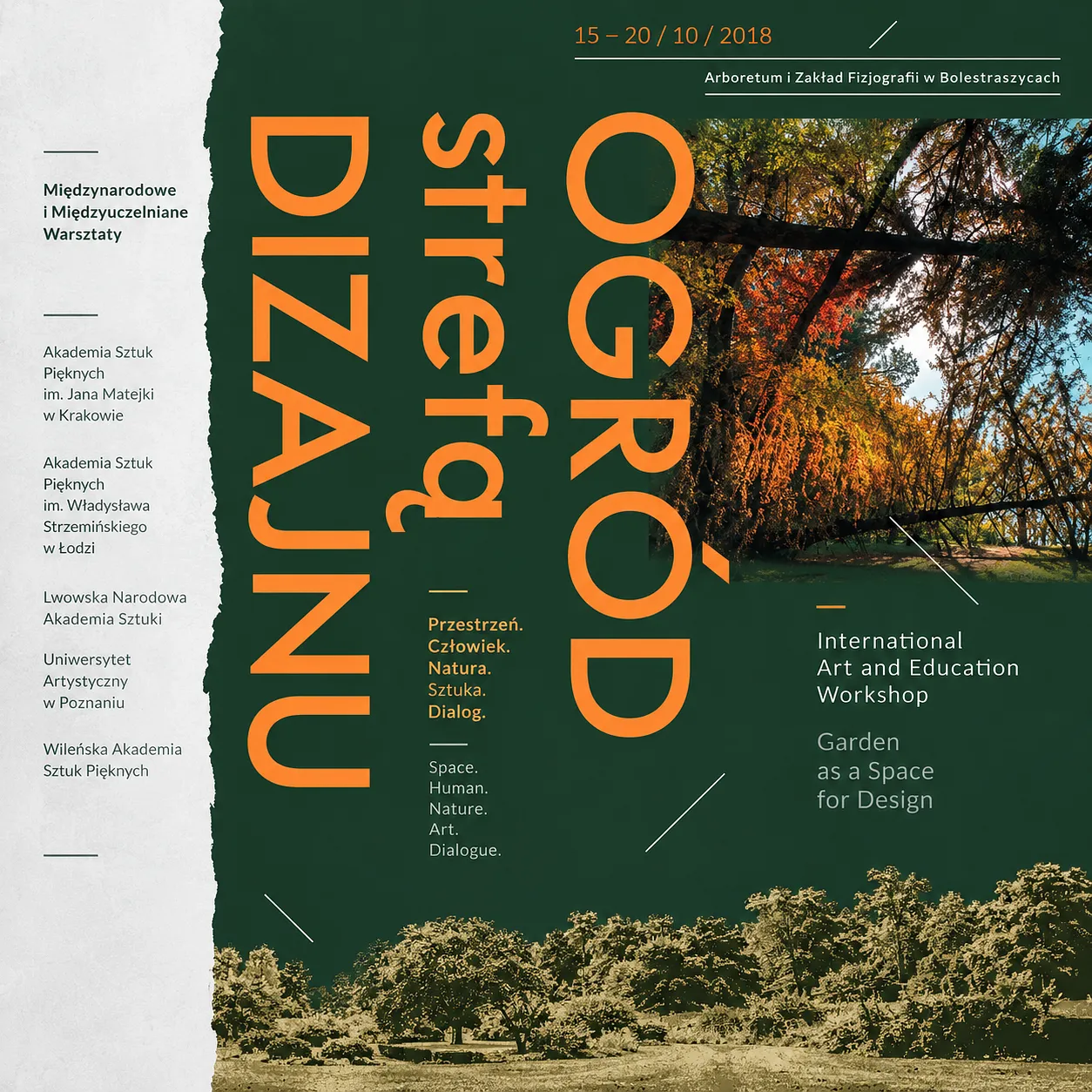
Space. People. Nature. Art. Dialogue.
These five words appeared on the project poster in 2018. For me, they still capture its essence most precisely.