THE MARIUSZ KAZANA INDEX
2012–present · Ukraine — Poland
International Graphic Art Competition
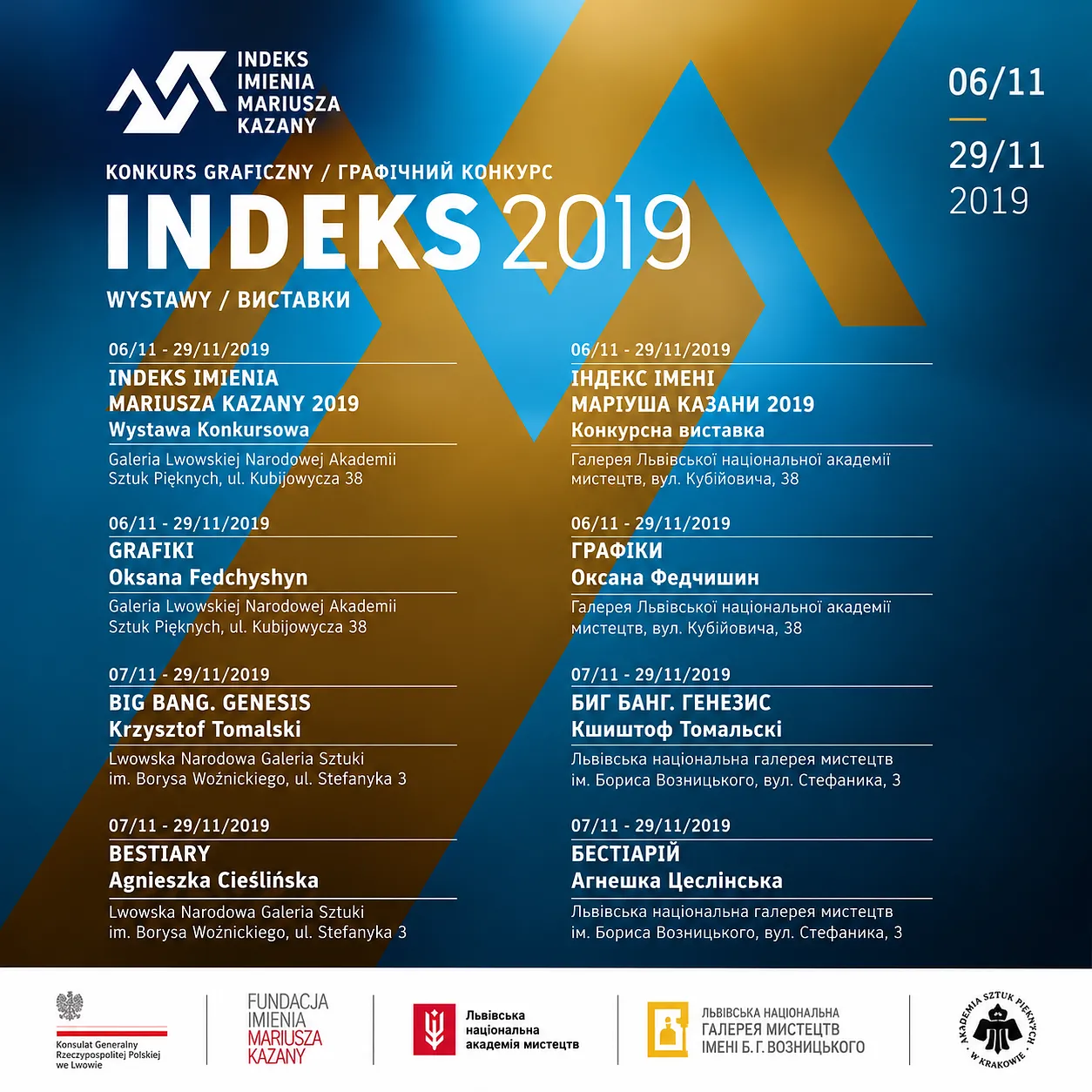
The Mariusz Kazana Index was established in 2012 at the initiative of the Consulate General of the Republic of Poland in Lviv. It honours the memory of Polish diplomat Mariusz Kazana, who died in the plane crash near Smolensk on 10 April 2010. I joined the project as a co-organiser representing the Lviv National Academy of Arts.
During our first working meetings at the consulate, we began to see that the competition could serve a broader purpose. We wanted to preserve and develop the traditions of the Lviv school of printmaking, support young artists, strengthen Ukrainian-Polish cultural dialogue, and promote Ukrainian and Polish art in both countries.
The first competition was modest in scale and took place without a separate exhibition. An international jury of approximately twelve representatives of Polish and Ukrainian institutions assessed the works. With each subsequent edition, however, the project grew: more artists entered, the professional standard and scope of the submissions increased, and the exhibition programme expanded.
The competition was open to students and graduates from different departments of LNAA, rather than students of a single discipline. This allowed a much wider group of young artists to explore graphic art as a field for experimentation.
From the outset, the award was conceived as more than a financial prize. The winner received the opportunity to undertake a placement at a partner art academy in Poland and work in its professional printmaking studios. For young artists, this was exceptionally valuable. They gained access to equipment and techniques that were not available to them in Lviv at the time and could develop their skills in etching, screen printing, and other printmaking techniques.
The placement opened further doors. The young artist could hold a solo exhibition, publish a small catalogue, and create an original Christmas card for the Polish diplomatic network. A single award thus set a series of opportunities in motion: competition → placement → new technical experience → solo exhibition → catalogue → international presentation.
An exhibition programme gradually grew around the competition in Lviv. It included a display of competition entries, a presentation by the previous edition’s winner, and exhibitions by faculty members of the partner Polish academy. Students could encounter the work and professional approaches of established Polish printmakers directly, comparing artistic schools, techniques, and ways of thinking.
The Lviv presentations also expanded across the city. The LNAA Gallery remained a regular venue, while other events took place in local museums and galleries. The most recent editions of the competition have been presented at the Andrey Sheptytsky National Museum in Lviv.
For me, one of the project’s most significant outcomes is that its influence can now be seen beyond exhibitions and catalogues. Some former winners have gone on to join the faculty of LNAA’s Department of Graphic Design. The experience once gained by young artists has returned to the Academy through their teaching.
The competition continues today and is approaching its 13th edition. A younger generation has gradually taken over its organisation. To me, this is one of the clearest signs of the project’s vitality: the model we created has continued to develop beyond the work of its first organisers.
Being part of this mission mattered to me: creating opportunities for young artists to step beyond their familiar surroundings, gain new professional experience, and eventually pass it on to the next generation.