.jpg?locale=en)
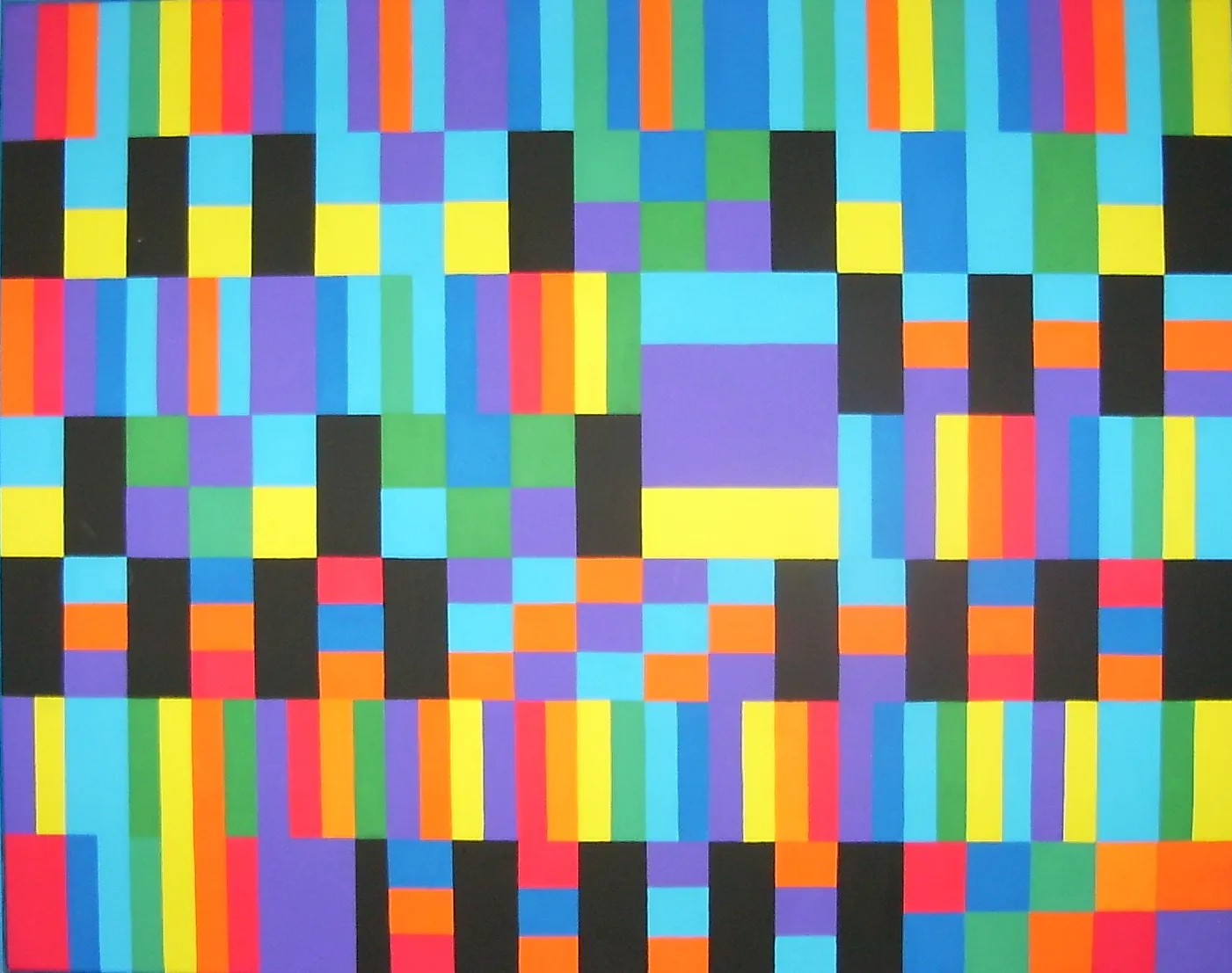
"New London. Part I. Sigmeister — "Transformation" Series. (2005)
Year
2005
Dimensions
70Х90 см
Materials
acrylic on canvas
Medium
Painting
Series
TRANSFORMATION
Price
$4500
Shipping cost depends on location
90 × 70 cm
In this work, the principle of musical composition is transformed into an almost architectonic system. Vertical bands of colour, rectangular modules, and black pauses construct a complex rhythm in which colour functions much like sound — through repetition, changes in duration, accent, and silence.
The composition does not develop around a single centre, but unfolds as a polyphonic structure. Individual chromatic sequences emerge, break off, transform, and return at a different scale. Black planes become significant pauses between colour “phrases,” while variations in the width and height of the modules create a sense of differing durations.
The title New London introduces another possible level of interpretation: the rhythmic structure may evoke a large city — its verticals, movement, light, fragmentation, and the simultaneous existence of multiple events. Yet the city is not depicted literally. Instead, it is transformed into a system of chromatic rhythms.
In New London. Part I, painting becomes a kind of score in which colour, form, interval, and pause generate a visual music of their own. This principle — the transformation of one mode of perception into another — lies at the heart of the Transformation series.
Buy "New London. Part I. Sigmeister — "Transformation" Series. (2005)
Year
2005
Dimensions
70Х90 см
Materials
acrylic on canvas
Medium
Painting
Series
TRANSFORMATION
Price
$4500
Shipping cost depends on location
In this work, the principle of musical composition is transformed into an almost architectonic system. Vertical bands of colour, rectangular modules, and black pauses construct a complex rhythm in which colour functions much like sound — through repetition, changes in duration, accent, and silence.
The composition does not develop around a single centre, but unfolds as a polyphonic structure. Individual chromatic sequences emerge, break off, transform, and return at a different scale. Black planes become significant pauses between colour “phrases,” while variations in the width and height of the modules create a sense of differing durations.
The title New London introduces another possible level of interpretation: the rhythmic structure may evoke a large city — its verticals, movement, light, fragmentation, and the simultaneous existence of multiple events. Yet the city is not depicted literally. Instead, it is transformed into a system of chromatic rhythms.
In New London. Part I, painting becomes a kind of score in which colour, form, interval, and pause generate a visual music of their own. This principle — the transformation of one mode of perception into another — lies at the heart of the Transformation series.
Ask "New London. Part I. Sigmeister — "Transformation" Series. (2005)
Year
2005
Dimensions
70Х90 см
Materials
acrylic on canvas
Medium
Painting
Series
TRANSFORMATION
Price
$4500
Shipping cost depends on location
In this work, the principle of musical composition is transformed into an almost architectonic system. Vertical bands of colour, rectangular modules, and black pauses construct a complex rhythm in which colour functions much like sound — through repetition, changes in duration, accent, and silence.
The composition does not develop around a single centre, but unfolds as a polyphonic structure. Individual chromatic sequences emerge, break off, transform, and return at a different scale. Black planes become significant pauses between colour “phrases,” while variations in the width and height of the modules create a sense of differing durations.
The title New London introduces another possible level of interpretation: the rhythmic structure may evoke a large city — its verticals, movement, light, fragmentation, and the simultaneous existence of multiple events. Yet the city is not depicted literally. Instead, it is transformed into a system of chromatic rhythms.
In New London. Part I, painting becomes a kind of score in which colour, form, interval, and pause generate a visual music of their own. This principle — the transformation of one mode of perception into another — lies at the heart of the Transformation series.
.jpg?locale=en)