Cosmology 4 — "Presence" Series (2015)
Year
2015
Dimensions
70 х70 см
Materials
pastel, paper
Medium
Graphics
Series
PRESENCE
Price
$3500
Shipping cost depends on location
70 × 70 cm
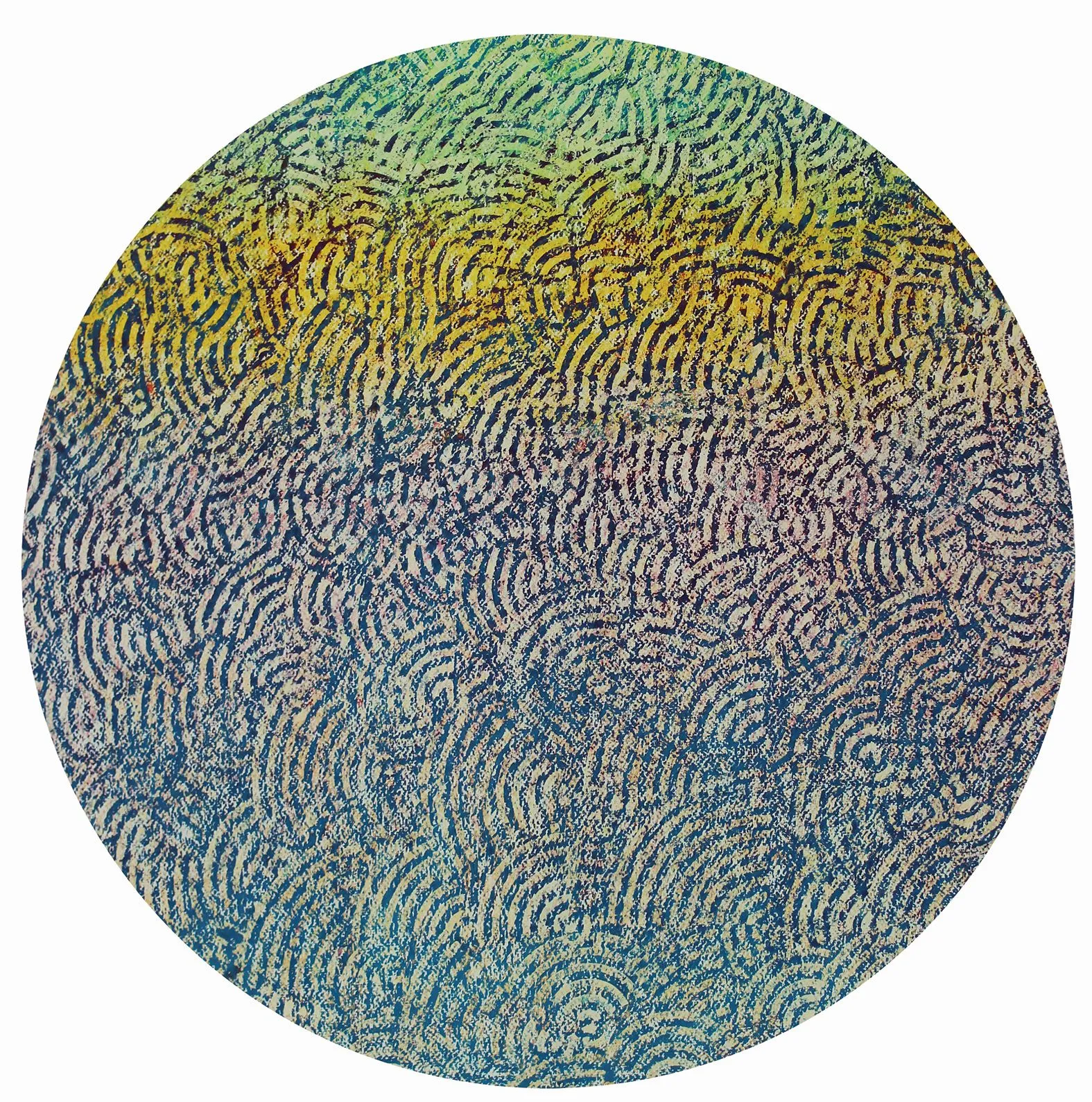
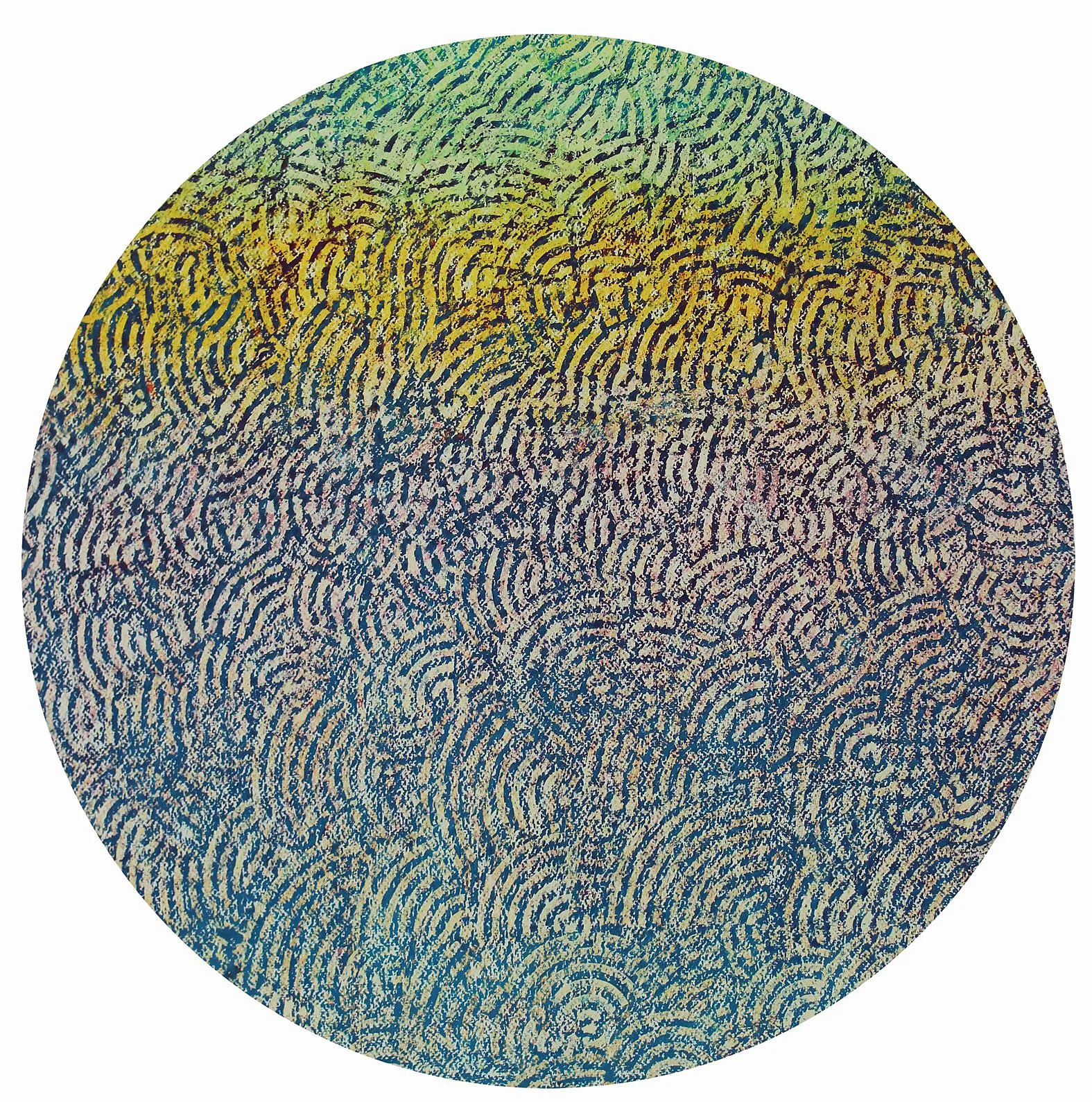
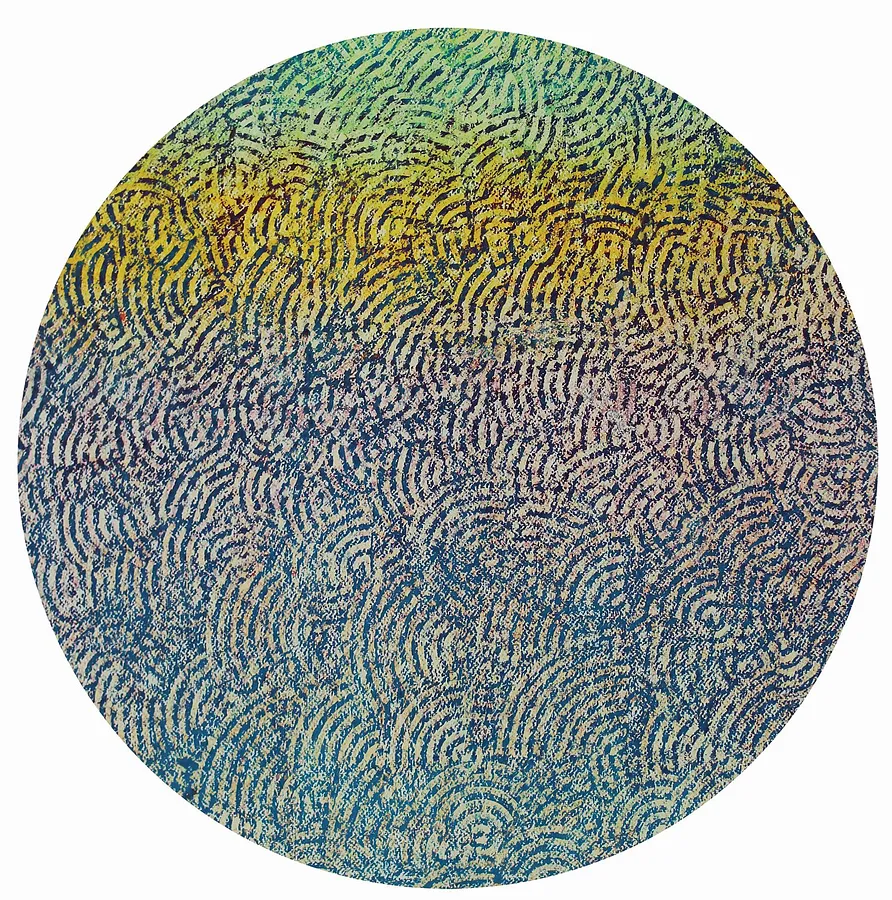
In Cosmology 4, the circular form appears as a unified field of vibrations, almost entirely devoid of individual events or distinct points of emphasis. In contrast to the more pronounced structures of Cosmology 5–7, here the field becomes calmer and more homogeneous — as though we are witnessing not separate impulses, but the overall state of an environment.
Thousands of short, arc-like traces cover the entire surface of the sphere. They shift direction, converge and diverge, forming local currents and vortices. They evoke waves passing through matter, or an invisible force field that becomes perceptible only through the patterns of its vibrations.
Colour also behaves as a field. Cool blue and turquoise tones gradually transition into muted areas of violet, yellow, and green. The boundaries between them remain blurred: one state slowly transforms into another, as though we were looking at a map of varying intensities within a single field of energy.
Importantly, the circular form provides no indication of scale. It may resemble a planet, a cell, a cross-section of unknown matter, the surface of water, or a space observed from a perspective inaccessible to human perception. Microcosm and macrocosm once again become interchangeable.
Cosmology 4 is an attempt to imagine space as a field of invisible presence. It cannot be seen directly — only sensed through rhythm, vibration, and the traces left upon the surface of matter.
Buy Cosmology 4 — "Presence" Series (2015)
Year
2015
Dimensions
70 х70 см
Materials
pastel, paper
Medium
Graphics
Series
PRESENCE
Price
$3500
Shipping cost depends on location
In Cosmology 4, the circular form appears as a unified field of vibrations, almost entirely devoid of individual events or distinct points of emphasis. In contrast to the more pronounced structures of Cosmology 5–7, here the field becomes calmer and more homogeneous — as though we are witnessing not separate impulses, but the overall state of an environment.
Thousands of short, arc-like traces cover the entire surface of the sphere. They shift direction, converge and diverge, forming local currents and vortices. They evoke waves passing through matter, or an invisible force field that becomes perceptible only through the patterns of its vibrations.
Colour also behaves as a field. Cool blue and turquoise tones gradually transition into muted areas of violet, yellow, and green. The boundaries between them remain blurred: one state slowly transforms into another, as though we were looking at a map of varying intensities within a single field of energy.
Importantly, the circular form provides no indication of scale. It may resemble a planet, a cell, a cross-section of unknown matter, the surface of water, or a space observed from a perspective inaccessible to human perception. Microcosm and macrocosm once again become interchangeable.
Cosmology 4 is an attempt to imagine space as a field of invisible presence. It cannot be seen directly — only sensed through rhythm, vibration, and the traces left upon the surface of matter.
Ask Cosmology 4 — "Presence" Series (2015)
Year
2015
Dimensions
70 х70 см
Materials
pastel, paper
Medium
Graphics
Series
PRESENCE
Price
$3500
Shipping cost depends on location
In Cosmology 4, the circular form appears as a unified field of vibrations, almost entirely devoid of individual events or distinct points of emphasis. In contrast to the more pronounced structures of Cosmology 5–7, here the field becomes calmer and more homogeneous — as though we are witnessing not separate impulses, but the overall state of an environment.
Thousands of short, arc-like traces cover the entire surface of the sphere. They shift direction, converge and diverge, forming local currents and vortices. They evoke waves passing through matter, or an invisible force field that becomes perceptible only through the patterns of its vibrations.
Colour also behaves as a field. Cool blue and turquoise tones gradually transition into muted areas of violet, yellow, and green. The boundaries between them remain blurred: one state slowly transforms into another, as though we were looking at a map of varying intensities within a single field of energy.
Importantly, the circular form provides no indication of scale. It may resemble a planet, a cell, a cross-section of unknown matter, the surface of water, or a space observed from a perspective inaccessible to human perception. Microcosm and macrocosm once again become interchangeable.
Cosmology 4 is an attempt to imagine space as a field of invisible presence. It cannot be seen directly — only sensed through rhythm, vibration, and the traces left upon the surface of matter.