Primary Movement XI — "Prima Motus" Series (2026)
Year
2026
Materials
mixed media on canvas
Medium
Painting
Series
PRIMA MOTUS
Price
Price on request
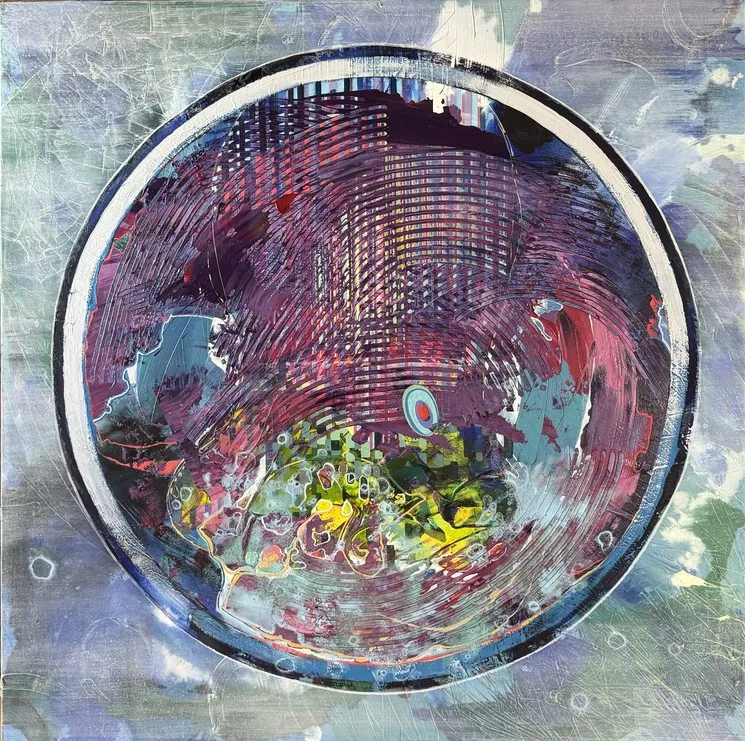
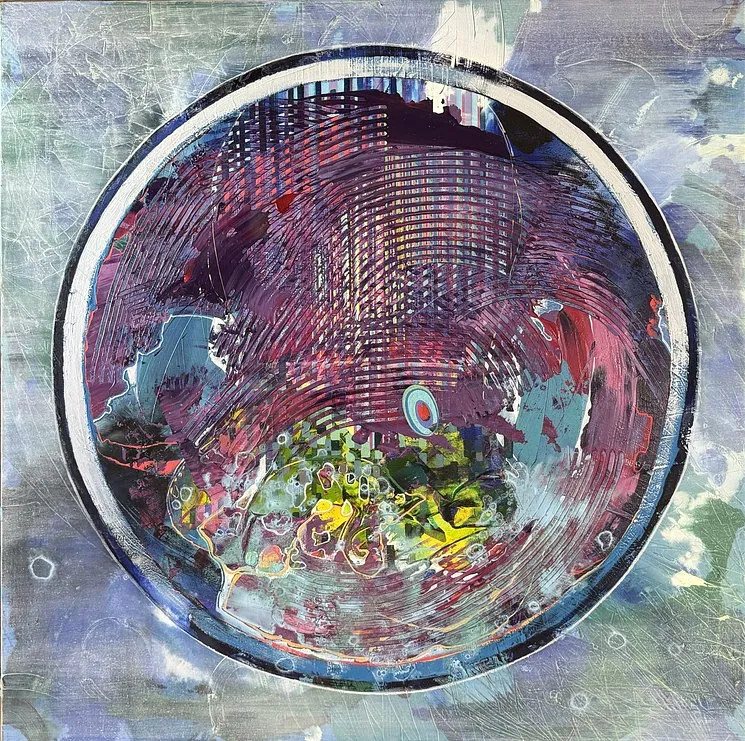
Primary Movement XI develops the theme of creation as a continuous process of emergence, interaction, and transformation of forms. A large sphere appears as a kind of autonomous space within which complex forms of life begin to emerge.
In the lower part of the sphere, vibrant green, yellow, blue, and pink forms are concentrated. Their silhouettes begin to acquire a degree of recognisability — evoking cellular structures, fragments of plants, microorganisms, or other natural formations — yet never resolve into specific images. They remain at the threshold between the recognisable and the unknown, as though nature itself were experimenting with possible ways of its future existence.
Above them unfolds a complex system of rhythmic lines, forming a kind of energy grid. Its wave-like movement extends across the sphere's interior, creating a sense of an invisible field in which forms emerge, interact, and transform.
A small concentric form near the centre becomes a point of particular tension — a kind of impulse or signal amid the continuous movement. Around it, different states coexist: freely evolving organic silhouettes and the ordered structure of energy waves.
The cool blue-grey space beyond the sphere reinforces the sense of autonomy of this inner world. The clearly defined circular boundary seems to hold it within a moment of becoming.
Primary Movement XI explores creation as a process in which forms gradually emerge from energy and movement, already carrying within them the outlines of a future natural world.
Buy Primary Movement XI — "Prima Motus" Series (2026)
Year
2026
Materials
mixed media on canvas
Medium
Painting
Series
PRIMA MOTUS
Price
Price on request
Primary Movement XI develops the theme of creation as a continuous process of emergence, interaction, and transformation of forms. A large sphere appears as a kind of autonomous space within which complex forms of life begin to emerge.
In the lower part of the sphere, vibrant green, yellow, blue, and pink forms are concentrated. Their silhouettes begin to acquire a degree of recognisability — evoking cellular structures, fragments of plants, microorganisms, or other natural formations — yet never resolve into specific images. They remain at the threshold between the recognisable and the unknown, as though nature itself were experimenting with possible ways of its future existence.
Above them unfolds a complex system of rhythmic lines, forming a kind of energy grid. Its wave-like movement extends across the sphere's interior, creating a sense of an invisible field in which forms emerge, interact, and transform.
A small concentric form near the centre becomes a point of particular tension — a kind of impulse or signal amid the continuous movement. Around it, different states coexist: freely evolving organic silhouettes and the ordered structure of energy waves.
The cool blue-grey space beyond the sphere reinforces the sense of autonomy of this inner world. The clearly defined circular boundary seems to hold it within a moment of becoming.
Primary Movement XI explores creation as a process in which forms gradually emerge from energy and movement, already carrying within them the outlines of a future natural world.
Ask Primary Movement XI — "Prima Motus" Series (2026)
Year
2026
Materials
mixed media on canvas
Medium
Painting
Series
PRIMA MOTUS
Price
Price on request
Primary Movement XI develops the theme of creation as a continuous process of emergence, interaction, and transformation of forms. A large sphere appears as a kind of autonomous space within which complex forms of life begin to emerge.
In the lower part of the sphere, vibrant green, yellow, blue, and pink forms are concentrated. Their silhouettes begin to acquire a degree of recognisability — evoking cellular structures, fragments of plants, microorganisms, or other natural formations — yet never resolve into specific images. They remain at the threshold between the recognisable and the unknown, as though nature itself were experimenting with possible ways of its future existence.
Above them unfolds a complex system of rhythmic lines, forming a kind of energy grid. Its wave-like movement extends across the sphere's interior, creating a sense of an invisible field in which forms emerge, interact, and transform.
A small concentric form near the centre becomes a point of particular tension — a kind of impulse or signal amid the continuous movement. Around it, different states coexist: freely evolving organic silhouettes and the ordered structure of energy waves.
The cool blue-grey space beyond the sphere reinforces the sense of autonomy of this inner world. The clearly defined circular boundary seems to hold it within a moment of becoming.
Primary Movement XI explores creation as a process in which forms gradually emerge from energy and movement, already carrying within them the outlines of a future natural world.